Live global earthquake monitor ·
USGS data
The timing was extraordinary. At 5:04 in the afternoon of October 17, 1989, millions of people across North America were watching a baseball game. Game 3 of the World Series, between the Oakland Athletics and the San Francisco Giants, was about to begin at Candlestick Park. The ABC broadcast was live. The cameras were on. When a M6.9 earthquake struck the Santa Cruz Mountains and its shaking reached the Bay Area fifteen seconds later, it was witnessed in near-real-time by an estimated 60 million viewers — the largest audience ever to watch an earthquake unfold.
The earthquake lasted about fifteen seconds. In that time, a section of the upper deck of the San Francisco-Oakland Bay Bridge fell onto the lower deck. A 1.25-mile stretch of the double-deck Cypress Street Viaduct on Interstate 880 in Oakland collapsed, crushing the cars on the lower level beneath the weight of the upper roadway. In the Marina District of San Francisco, buildings on artificial fill liquefied and sank, gas lines ruptured, and fires began. Sixty-three people died — a number that seems impossibly small for a Bay Area earthquake of this magnitude, until you see exactly where those deaths occurred and understand what nearly happened everywhere else.
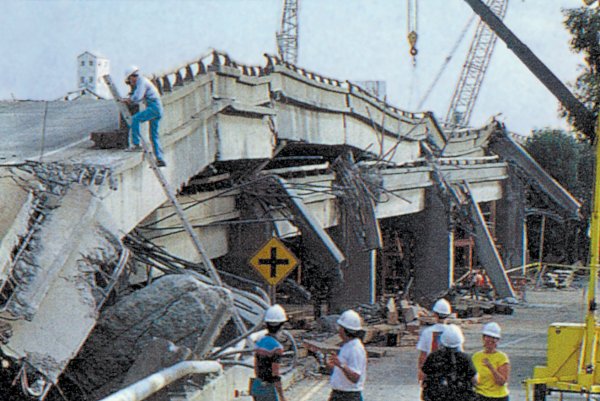
The Cypress Viaduct
Forty-two of the sixty-three deaths occurred in one place: the Cypress Street Viaduct, a double-deck elevated freeway carrying I-880 through a working-class neighbourhood in West Oakland. Built in the 1950s, its column-and-bent design had already been identified by California transportation engineers as potentially vulnerable in a major earthquake. The state's seismic retrofit program had been working through structures in this category — but had not yet reached the Cypress Viaduct.
When the Loma Prieta earthquake struck, the upper roadway of the viaduct fell onto the lower roadway for a distance of approximately 50 city blocks. Cars in the lower lanes were crushed between the two concrete decks. Survivorship was almost random: vehicles that happened to be positioned at column nodes — the few points where the structure held — survived. The others did not. Rescue workers spent days cutting through the pancaked concrete, guided by sounds from people still alive in crushed cars. The last survivor was pulled out more than 24 hours after the collapse.
A Bay Area of Known Vulnerabilities
The Loma Prieta earthquake struck on a segment of the San Andreas Fault system in the Santa Cruz Mountains, about 70 kilometres southeast of San Francisco. That distance mattered: the shaking that reached the Bay Area was already attenuated. In Santa Cruz and the surrounding mountains, damage was severe — the city's historic Pacific Garden Mall district was destroyed, Watsonville was heavily damaged, large landslides closed mountain roads. In the Bay Area itself, the shaking was enough to expose every weakness in the infrastructure, but not enough to destroy buildings that had been built to modern standards.
The Marina District was the exception. Built on artificial fill — including rubble from the 1906 earthquake dumped into the bay — the district sat on soil that geotechnical engineers had specifically identified as liquefaction-prone. It performed exactly as predicted. Buildings settled and tilted. Gas lines fractured and ignited. Within hours, fires were burning in the neighbourhood, and the city dispatched fireboats to pump bay water when the street mains failed. The Marina fire burned for much of the night. The district's combination of poor soil conditions and older wood-frame construction made it the closest analogue, within the Bay Area's 1989 experience, to what a truly near-field rupture of the San Andreas itself might produce.
What Television Did
The live World Series broadcast created something unusual: an earthquake that most Americans first encountered as television. The ABC anchor Al Michaels, on air at Candlestick Park, was cut off mid-sentence as the broadcast went dark. When it came back, helicopters were already over the Bay Bridge, filming the gap in its upper deck. That image — a 50-foot section of roadway collapsed onto the level below — was broadcast around the world within minutes of the earthquake.
The television dimension had real consequences. Political pressure to respond visibly and immediately was intense from the first hour. President George H.W. Bush visited the Bay Area within days. Federal disaster funding was authorised quickly. And the sustained coverage of the Cypress Viaduct rescue operation maintained public and political attention on the relief effort over the following days — the kind of sustained focus that disasters witnessed only by their survivors rarely sustain. The earthquake had an audience, and that audience had leverage.
What the Bay Area Did Next
The Loma Prieta earthquake fundamentally reshaped the Bay Area's approach to its seismic future. The Embarcadero Freeway — an elevated structure in San Francisco that had been controversial since the day it was built — was damaged in the earthquake and, after a long political debate, was never rebuilt. Its demolition in 1991 opened the waterfront to the form it holds today. The Cypress Viaduct was replaced with a surface boulevard. The Bay Bridge's eastern span was eventually replaced entirely, with the new structure completed in 2013.
More broadly, Loma Prieta accelerated a regional seismic retrofit program that had moved slowly for years. Unreinforced masonry buildings — the brick structures common in older Bay Area commercial districts, the same type that had killed people in 1906 — became subject to mandatory retrofit requirements in San Francisco and other cities. The earthquake showed in a way that policy documents had not that the Bay Area's infrastructure had known vulnerabilities, and that the cost of not retrofitting, paid in lives and money when the earthquake arrived, would far exceed the cost of retrofitting in advance.